
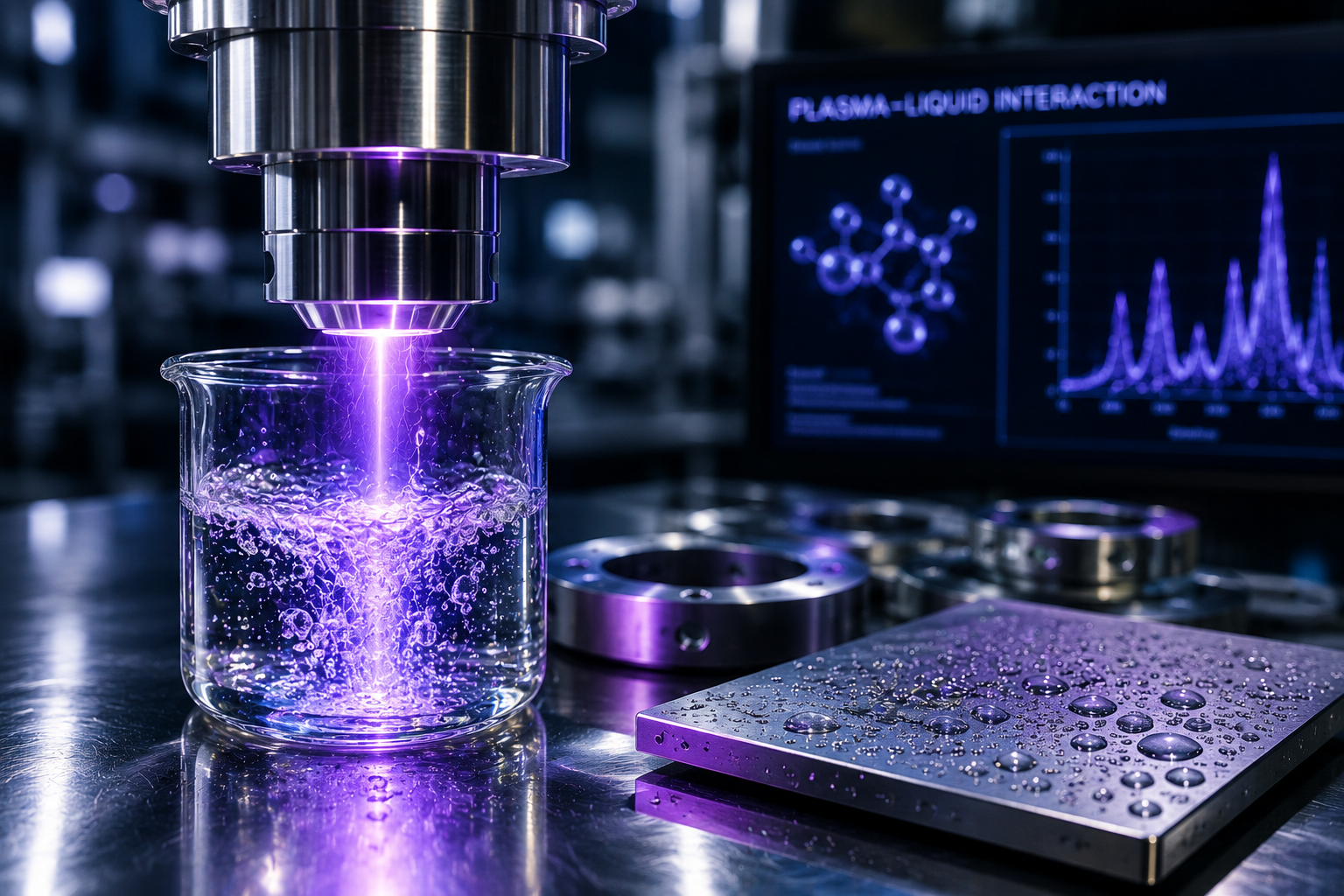
Plasma Activated Fluids and the Future of Material & Fluid Engineering
Plasma Activated Fluids are emerging as an important area of interdisciplinary engineering research, combining plasma physics, fluid science, surface engineering, and materials science. Increasingly, researchers are investigating how plasma-liquid interactions may alter chemical environments and influence future industrial, agricultural, and biological systems.
Modern engineering increasingly focuses on controlling interactions rather than simply processing materials. Plasma-enabled technologies provide a pathway for studying highly controlled energy-driven modifications across surfaces, liquids, and engineered environments.
For Luminari Synergy Pvt. Ltd., these scientific principles represent foundational research directions connecting plasma activation systems with next-generation engineering applications.
What Is Material & Fluid Engineering?
Material and fluid engineering is an interdisciplinary field investigating how materials and fluids interact, behave, and can be modified within engineered systems.
The discipline combines concepts from:
- materials science
- fluid mechanics
- chemical engineering
- surface physics
- process engineering
Engineering systems frequently depend on interactions occurring at interfaces rather than within isolated materials.
Examples include:
- coating systems
- industrial reactors
- biological fluids
- manufacturing environments
- agricultural processing systems
Material Science Fundamentals
Materials exhibit properties governed by:
- Surface chemistry
- Molecular structure
- Interfacial interactions
- Energy transfer mechanisms
Understanding these interactions enables optimization of industrial systems.
Mini Summary:
Modern engineering increasingly emphasizes control over material behavior rather than simple fabrication.
Evolution of Material and Fluid Engineering
Historically, industrial systems relied heavily on mechanical and chemical processing methods.
Traditional approaches involved:
- thermal treatment
- chemical coatings
- mechanical modification
- solvent-based systems
Industrial engineering later shifted toward precision approaches.
Materials science advancements increasingly introduced:
- nanotechnology
- surface engineering
- advanced processing systems
- plasma-based treatment approaches
Research through ASM International continues documenting material processing evolution.
Modern engineering increasingly favors controlled and targeted interventions.
The Science Behind Plasma Activation Technologies
Plasma is commonly defined as the fourth state of matter.
Unlike ordinary gases, plasma contains:
- ions
- electrons
- excited particles
- electromagnetic interactions
Plasma formation occurs when sufficient energy ionizes gases.
According to NASA Plasma Physics Research, plasma dominates much of the observable universe.
Reactive Species Generation
Plasma interactions frequently generate reactive molecular environments.
Key groups include:
Reactive Oxygen Species (ROS)
Examples:
- O radicals
- OH radicals
- ozone
- hydrogen peroxide
Reactive Nitrogen Species (RNS)
Examples:
- NO
- NO₂
- nitrogen intermediates
Generation mechanisms include:
- Electron impact collisions
- Dissociation reactions
- Ionization pathways
- secondary molecular interactions
These species participate in complex chemical interactions.
Research databases including NIH and NCBI continue investigating these mechanisms.
Plasma Activated Fluids: Scientific Principles
Plasma-liquid interaction systems involve exposing fluids to plasma-generated energy environments.
These interactions can alter chemical compositions and create reactive molecular species.
Research suggests plasma exposure may generate:
- reactive oxygen species
- reactive nitrogen species
- dissolved molecular intermediates
Resulting fluid chemistry becomes highly dynamic.
Activation Mechanisms
Important mechanisms include:
- diffusion processes
- gas-liquid interactions
- charge transfer pathways
- radical chemistry
Small changes in operating conditions can significantly influence outcomes.
Biological and Industrial Implications
Current studies suggest activated fluids may influence:
- biological environments
- microbial systems
- material interactions
- process chemistry
However, observed effects remain strongly dependent upon experimental conditions.
Research available through ScienceDirect discusses evolving findings.
Mini Summary:
Plasma activated fluids remain an active area of research rather than a fully standardized technology domain.
Surface Engineering Through Plasma Technologies
Surface engineering increasingly relies on plasma technologies because surface behavior often governs material performance.
Plasma systems may modify:
Surface Energy
Surface energy influences interaction characteristics.
Wettability Changes
Experimental studies indicate plasma treatments can alter wetting behavior.
Adhesion Enhancement
Plasma processing may improve material bonding conditions.
Sterilization Systems
Cold plasma research increasingly investigates microbial control applications.
Coating Preparation
Surface activation frequently precedes advanced coatings.
Research through Springer Materials Science discusses multiple treatment approaches.
Applications in Agriculture and Industrial Systems
Agriculture
Emerging agricultural investigations include:
Plasma Activated Water
Current studies suggest plasma-treated fluids may influence biological systems.
Mechanisms continue being investigated.
Seed Treatment
Experimental research indicates plasma exposure may alter:
- surface characteristics
- hydration behavior
- germination-related responses
Outcomes vary considerably.
Industrial Systems
Industrial applications include:
Semiconductor Processing
Plasma technologies remain fundamental within semiconductor manufacturing.
Research from IEEE Xplore extensively documents these applications.
Medical Sterilization
Cold plasma research increasingly investigates sterilization pathways.
Materials Engineering
Applications include:
- surface modification
- coatings
- advanced material preparation
Current Engineering Challenges
Several challenges continue limiting broader implementation.
Process Scalability
Laboratory systems often encounter industrial translation difficulties.
Repeatability
Biological and material systems can respond variably.
Cost Constraints
Engineering optimization remains necessary.
Energy Optimization
Efficiency improvements continue receiving research attention.
Industrial Integration
Future implementation requires compatibility with existing systems.
These remain active engineering challenges.
Future Research Directions
Future engineering systems increasingly move toward intelligent adaptive technologies.
Research directions include:
AI-Assisted Engineering Systems
Machine learning may support process optimization.
Smart Plasma Processing
Future systems may allow more precise chemistry control.
Precision Materials Design
Greater customization of material interactions is increasingly investigated.
Advanced Environmental Applications
Emerging research areas include:
- water systems
- environmental processing
- sustainable industrial engineering
Future progress will likely depend on multidisciplinary research collaboration.