
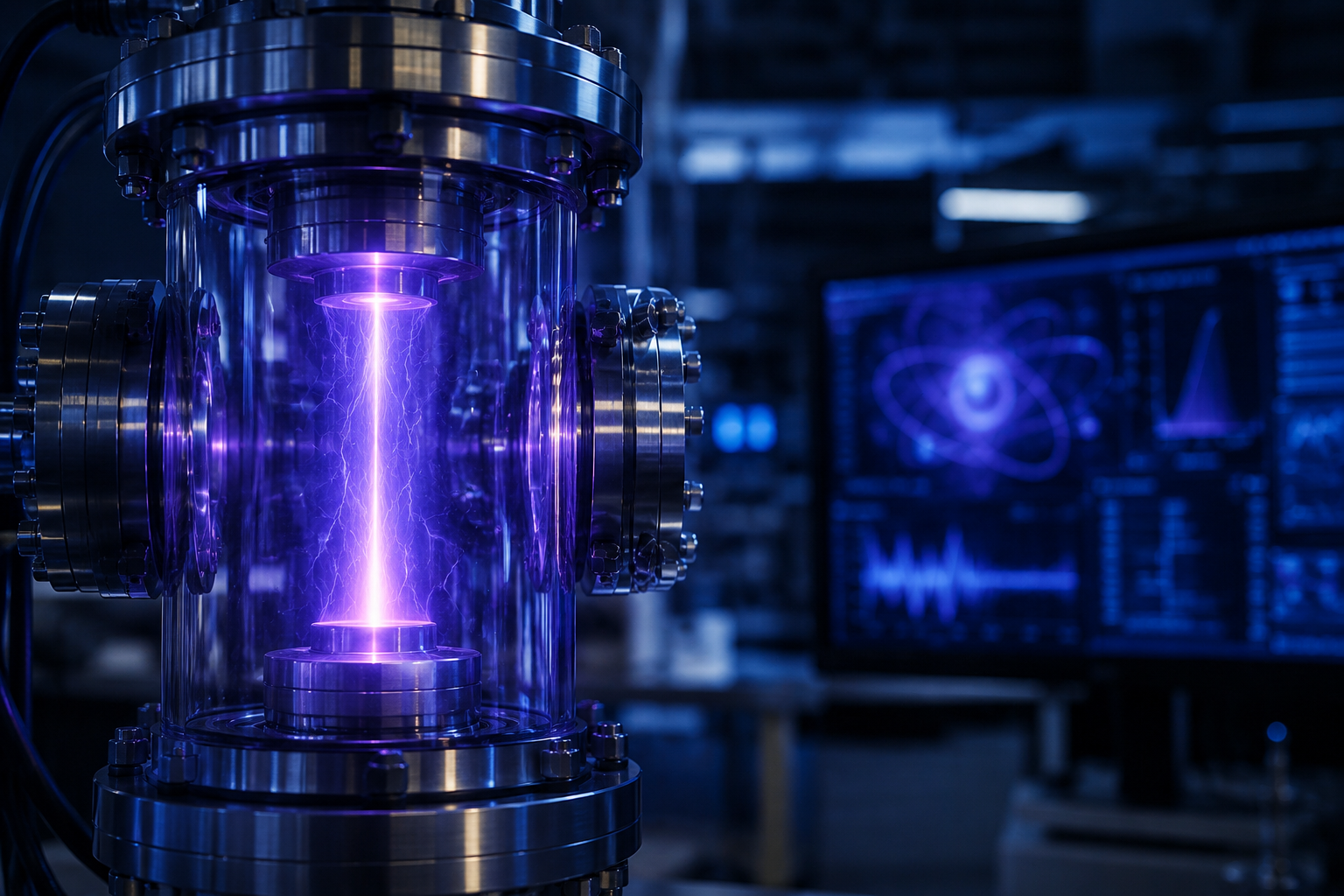
Non Thermal Plasma Engineering represents one of the most active and multidisciplinary areas within modern plasma research. Its significance extends beyond theoretical physics into agriculture, medicine, environmental science, advanced manufacturing, and emerging deep-tech systems. As scientific communities seek technologies capable of precise chemical and biological interactions under controlled conditions, non-equilibrium plasma systems continue attracting substantial research attention.
Plasma science increasingly operates at the intersection of physics, chemistry, materials science, and biological engineering. Understanding the underlying mechanisms of plasma interactions is therefore becoming essential for future technology development.
Luminari Synergy Pvt. Ltd. approaches plasma research through scientific principles grounded in plasma physics, reactive species engineering, fluid activation systems, and applied deep-tech innovation.
What Is Advanced Plasma Physics?
Advanced plasma physics studies highly ionized matter and investigates the interactions of charged particles, electromagnetic fields, reactive species, and complex energy-transfer mechanisms.
Plasma is commonly described as the fourth state of matter, alongside:
- solids
- liquids
- gases
Unlike neutral gases, plasma contains:
- ions
- electrons
- neutral particles
- excited species
- electromagnetic interactions
This ionization creates behavior fundamentally different from ordinary matter.
Scientific Foundation
The plasma state emerges when sufficient energy separates electrons from atoms.
Key governing principles include:
- Electromagnetic field interactions
- Particle collisions
- Transport phenomena
- Energy transfer mechanisms
- Collective charged particle behavior
According to research from NASA Plasma Science, plasma constitutes over 99% of observable matter in the known universe.
Examples include:
- stars
- solar winds
- ionospheres
- lightning
- astrophysical environments
Mini Summary
Plasma behaves as a collective system where charged particles interact dynamically rather than independently.
Evolution of Plasma Physics Research
Plasma science developed over more than a century of research.
The modern term “plasma” was introduced by Irving Langmuir during investigations involving ionized gases in the 1920s.
Langmuir observed that ionized particle systems behaved collectively rather than as isolated particles.
Major historical milestones include:
Early Electrical Discharge Research
Studies involving:
- cathode rays
- gas discharges
- vacuum tubes
laid foundational understanding.
Fusion Research Era
Mid-20th century research accelerated plasma studies through nuclear fusion programs.
Organizations including the U.S. Department of Energy (DOE) Fusion Program expanded understanding of magnetically confined plasma systems.
Industrial Plasma Expansion
Industrial applications later introduced:
- semiconductor plasma processing
- material treatment
- plasma sterilization
- atmospheric plasma systems
Modern plasma research now spans laboratory and industrial environments.
The Science of Reactive Species Generation
Reactive species generation is among the most important mechanisms in non-thermal plasma engineering.
Plasma discharges generate highly reactive molecules through energy transfer and collision processes.
Major categories include:
Reactive Oxygen Species (ROS)
Examples:
- Atomic oxygen (O)
- Ozone (O₃)
- Hydroxyl radicals (OH)
- Hydrogen peroxide (H₂O₂)
Reactive Nitrogen Species (RNS)
Examples:
- Nitric oxide (NO)
- Nitrogen dioxide (NO₂)
- Peroxynitrite species
These molecules participate in chemical and biological reactions due to their energetic properties.
Studies indexed through NCBI Research Database and NIH Research Resources discuss reactive species roles across biological systems.
Generation Mechanisms
Reactive species formation occurs through:
- Electron impact collisions
- Dissociation reactions
- Excitation pathways
- Ionization processes
- Secondary reaction chains
The chemistry rapidly becomes highly complex.
Scientific Relevance
Reactive species influence:
- oxidation chemistry
- microbial interactions
- signaling pathways
- surface chemistry modifications
However, outcomes depend heavily on plasma conditions.
Current research suggests biological responses vary significantly according to treatment parameters.
Controlled Plasma Interactions
Precise control remains one of the most critical principles in advanced plasma engineering.
Plasma systems are highly sensitive.
Small changes may substantially alter generated chemistry.
Important control variables include:
Pressure
Pressure influences:
- collision frequency
- particle pathways
- energy distribution
Frequency
Electrical excitation frequency affects plasma discharge characteristics.
Voltage
Voltage determines energy transfer conditions.
Gas Composition
Common gases include:
- air
- nitrogen
- helium
- argon
- oxygen mixtures
Gas chemistry strongly affects reactive species profiles.
Exposure Duration
Longer treatment times may alter biological or material outcomes.
Why Control Matters
Repeatable engineering requires:
✔ stable chemistry
✔ reproducible conditions
✔ predictable interactions
✔ scalable performance
Without control, plasma systems become difficult to standardize.
Non-Thermal Plasma Systems
Non-thermal plasma systems differ fundamentally from thermal plasma environments.
In thermal plasma, particles reach near-equilibrium temperatures.
Non-thermal systems remain chemically energetic while maintaining relatively low bulk temperatures.
This distinction enables interaction with heat-sensitive materials.
Common systems include:
Dielectric Barrier Discharge (DBD)
Widely investigated in:
- agriculture
- sterilization
- environmental treatment
Atmospheric Pressure Plasma Jets
Useful for localized treatment systems.
Cold Plasma Engineering Systems
Cold plasma technologies operate without extreme heating.
Research literature available through Springer Plasma Research discusses various engineering configurations.
Advantages
- atmospheric operation
- biological compatibility
- chemical flexibility
- scalable architectures
Limitations
- parameter sensitivity
- repeatability issues
- process optimization challenges
Advanced Plasma Physics in Agriculture
Agricultural applications increasingly represent an important research direction.
Experimental studies indicate plasma technologies may influence plant-related systems through physical and chemical interactions.
Current areas under investigation include:
Seed Treatment
Studies suggest plasma exposure may alter:
- seed wettability
- germination characteristics
- surface properties
Crop Enhancement
Research continues evaluating biological responses in plants.
Observed effects vary across species and experimental conditions.
Plasma Activated Water
Plasma-activated fluids contain reactive molecular species generated during treatment.
Current research suggests such systems may influence biological interactions.
However, mechanisms remain under active investigation.
Microbial Interactions
Plasma-generated chemistry may affect surrounding microbial environments.
Responses remain dependent on:
- treatment intensity
- exposure conditions
- biological variability
Research available through ScienceDirect Plasma Agriculture Publications discusses current experimental findings.
Industrial Applications of Advanced Plasma Physics
Industrial plasma systems already operate across numerous sectors.
Surface Engineering
Plasma treatments modify:
- adhesion properties
- wettability
- material surfaces
Semiconductor Processing
Semiconductor manufacturing heavily relies on plasma etching technologies.
Research from IEEE Xplore documents extensive applications.
Sterilization Systems
Cold plasma technologies continue receiving attention for sterilization research.
Materials Science
Applications include:
- coatings
- nanomaterials
- surface activation
Current Challenges
Despite significant progress, challenges remain.
Scalability
Laboratory performance does not automatically translate into industrial systems.
Repeatability
Biological systems exhibit variability.
Energy Efficiency
Engineering optimization remains necessary.
Standardization
Researchers continue addressing reproducibility frameworks.
These limitations represent active research areas rather than solved problems.
Future Research Directions
Future plasma science may increasingly incorporate intelligent and adaptive systems.
Current research directions include:
AI-Assisted Plasma Systems
Machine learning may assist optimization and parameter prediction.
Precision Plasma Engineering
Future systems may enable greater chemical specificity.
Biological Plasma Applications
Interdisciplinary research continues expanding.
Environmental Technologies
Research areas include:
- pollution control
- water treatment
- sustainable systems
Advanced plasma research increasingly depends on multidisciplinary collaboration.